

|
|
| Glossary | |||
| Sales to Assets (or Asset Turnover) Ratio | |||
| Important Terms | |||
| The important financial terms found in this equation that need to be understood to fully comprehend this equation are... | |||
| Total Assets | |||
Total Assets are Balance Sheet entries reflecting the value of anything owned by a business that could be converted to cash. This would include Cash, Receivables or money that is owed to the business including money owed by clients that have purchased products or received services but have not paid yet. Inventory plus Net Fixed assets like equipment and buildings are some of the accounts included in Total Assets. In this case, Total Assets is calculated by the average of the last 3 months of Total Assets. Being that Assets are a snapshot in time, using the average of the last three months will smooth out large monthly variations. |
|||
| Sales or Revenue | |||
Sales or Revenue is the number reflected on the Income Statement representing total income over any given time period. Many call this the "Top Line". In this Metric Ratio, Sales is an annualized number calculated by adding up the last 3 months and then multiplying it by 4. Using the last 3 months for sales rather than the whole prior 12 months will allow the Sales to Assets ratio to respond faster than it would if the whole prior 12 months were included in the calculation. |
|||
| The Equation | |||
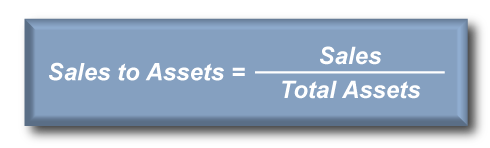
| The formula for this ratio is: Annual Sales divided by Total Assets. Using this method to calculate Sales is especially important to show you a bigger impact if you have done something to improve the number or something happened that caused the value to deteriorate so the Scorecard will automatically flag an issue. | |||
 |
|||
| What it means | |||
| If a business's sales are twice its assets, the sales to assets ratio is expressed as 2.0 and this would indicate that the business is doing a relatively good job at making use of its assets. A ratio of 1.0 or lower would indicate that the business has room for improvement. | |||
| Why it is important | |||
| Asset turnover is a key efficiency metric for any business as it measures how efficiently a business is using its assets to produce revenue. | |||